Key Takeaways
- Airbyte is specifically built for data movement. It offers one of the largest connector libraries with 600+ integrations, so you can extract and load data from niche sources. Its open-source and cloud flexibility is ideal if you want to manage your own deployment.
- Apache Airflow focuses on orchestrating complex, code-driven workflows. It manages dependencies, schedules, and multi-step processes across systems. It’s suitable if you require fine-grained control and custom logic.
You can also use them together, with Airbyte handling ingestion and Airflow coordinating downstream tasks like transformations.
If you want a simpler option that does both, Hevo combines ingestion, transformations, monitoring, and orchestration into a single, no-code platform without infrastructure overhead.
When you compare Airbyte vs Airflow, you realize these tools solve two different problems despite their similar data engineering goals.
Airbyte is an open-source platform designed to move data from a variety of sources using a large library of connectors. Airflow, on the other hand, focuses on orchestrating advanced, code-driven workflows that require precise scheduling and dependencies.
Selecting the right option depends on your data pipeline requirements and team expertise. This guide explores Airbyte and Airflow to understand their strengths and trade-offs.
By the end, you’ll know which tool matches your integration, orchestration, or end-to-end pipeline objectives.
Table of Contents
Airbyte vs Airflow vs Hevo: Detailed Comparison Table
 Try Hevo for Free Try Hevo for Free |  |  | |
| Core functions | Fully managed, no-code ELT/ETL | Open-source data movement and replication | Workflow orchestration and task scheduling |
| Ease of use | Easy | Moderate, technical | Technical, code-first |
| Connectors | 150+ | 600+ | 80+ providers |
| Real-time sync |  | |  |
| Infrastructure management | Fully managed | Self-managed or cloud | Self-managed |
| Transformations | dbt integration, Python, and SQL | dbt integration, PyAirbyte | Python |
| Workflow orchestration | Built-in orchestration | Basic job scheduling | Advanced DAGs |
| Monitoring | Complete real-time observability | Real-time logs | Web UI logs |
| Customer support | 24/7 chat, email | Active community, paid plans | Community unless through managed service |
| Security compliance | SOC 2 Type II, GDPR, HIPAA, DORA, and CPRA | SOC2 and ISO 27001 | Depends on deployment |
| Free plan | | | |
| Starting Price | $239/month | $10/month | Free, infrastructure cost applies |
What Is Airbyte?

G2 rating: 4.4 (75) | Gartner rating: 4.6 (66)
Airbyte is an open-source data integration tool that moves data from various sources into analytics destinations. It provides connectors with over 600 pre-built integrations across databases, SaaS applications, APIs, and files.
The platform supports self-hosted deployments and a managed cloud service, which gives you flexibility in how you run pipelines. It also addresses core ingestion challenges, such as schema evolution, retries, and incremental data syncs. It is ideal for organizations that want to avoid vendor lock-in while scaling data pipelines.
Key Features of Airbyte
- Cron-based scheduling: Supports cron expressions to define exact sync times without building or maintaining a separate scheduling system.
- Connector builder: Introduces an AI-powered connector builder that helps teams create custom integrations quickly when a required source is unavailable.
- dbt integration: Runs dbt models automatically after data loads to apply transformations within the same data workflow.
- Stream-level configuration: Provides stream-level control so each table or endpoint follows its own sync mode, frequency, and load behavior.
- State management for reliability: Saves the point where a sync stopped and resumes data transfer exactly where it left off after a network failure or interruption.
Use cases
- Near real-time backup: Store copies of SaaS and database data in a warehouse for recovery, audits, or historical analysis.
- Data lake construction: Ingest structured, semi-structured, and unstructured data from databases, APIs, and file storage into a unified lake for analytics and machine learning.
- Database analytics replica: Maintain a read-only copy of operational databases for analysis without impacting live application performance.
Pricing
Airbyte’s pricing ranges from fully open-source to enterprise-ready managed options.
- Core: Always free, self-managed, and open-source with a maximum sync frequency under 5 minutes.
- Standard: Starts at $10/month, fully managed cloud hosting with a maximum frequency of 1 hour.
- Plus: Fully managed cloud hosting and capacity-based pricing with a maximum frequency of 1 hour.
- Pro: Fully managed cloud, capacity-based pricing, multiple workspaces, premium support, and a maximum frequency of 15 minutes.
Pros and cons
Pros:
- Community-driven updates accelerate new connector development.
- Active Slack and GitHub support channels.
- PyAirbyte helps you run integrations directly within local Python scripts.
Cons:
- The open-source version requires users to handle their own infrastructure and scaling.
- The quality of connectors might differ due to the community-managed system.
- Regular manual updates are necessary to secure self-hosted versions.
Customer review


What Is Airflow?

G2 rating: 4.4 (118) | Gartner rating: NA
Airflow is an open-source workflow orchestration platform to programmatically author, schedule, and monitor workflows using Python. Its modular architecture supports multi-step pipelines and offers 80+ pre-built providers that enable connections to cloud platforms, databases, and services, such as AWS, GCP, and Azure.
Its core strength lies in treating workflows as code, which gives you fine-grained control over task logic, dependencies, and execution behavior at scale. It is most suitable for teams that require absolute control over intricate logic that extends beyond simple data ingestion.
Key features
- Horizontal scalability: Distributes tasks across multiple workers to support high-volume and compute-intensive workflows.
- Sensor-based operators: Waits for external conditions like file arrivals or API status changes before proceeding, with reschedule mode available to free up worker resources between checks.
- Cross-DAG orchestration: Connects independent workflows through triggers or sensors so that downstream pipelines start only after upstream DAGs are completed.
- Execution observability: Surfaces detailed task logs, execution timelines, and historical run data through a centralized web interface.
- Dynamic task mapping: Creates parallel tasks at runtime based on external inputs to scale workflows without predefined task limits.
Use cases
- Machine learning workflows: Automate model training, evaluation, deployment, and retraining schedules while handling data preparation and post-training checks.
- End-to-end analytics pipelines: Coordinate extraction, transformation, validation, and reporting jobs across multiple systems to ensure analytics outputs run in the correct order every time.
- Cross-cloud orchestration: Manage workflows that span multiple cloud platforms, warehouses, and third-party services without centralizing execution in one system.
Pricing
Airflow is free and open-source. However, running it involves infrastructure costs, such as servers, storage, and maintenance. Managed services, like Google Cloud Composer or AWS Managed Workflows for Apache Airflow, incur additional costs but simplify operational overhead.
Pros and cons
Pros:
- Applies retries, backoff strategies, alerts, and task-level error controls.
- Supports custom operators and hooks through the public SDK base class BaseOperator.
- Highly portable across on-premise and cloud environments.
Cons:
- No native data integration. You must code or connect integration components separately.
- Steep learning curve for non-Python users.
- Limited built-in data validation capabilities.
Customer review

You don’t have to choose between Airbyte’s connector support and Airflow’s workflow control, or manage both tools together. Hevo combines them in a single, no-code platform. It equips your team to:
- Avoid Airbyte’s connector maintenance and enjoy auto-schema handling, guaranteed sync reliability, and 150+ fully managed connectors.
- Use visual blocks, SQL, or Python using visual blocks or Python, with no DAGs or operator wiring
- Auto-orchestrated, auto-healing pipelines with no scheduling, no retries, and no manual fixes.
- Transparent, predictable pricing with no infrastructure costs, no connector upkeep, and no hidden fees.
Trusted by 2000+ customers and rated 4.7 on Capterra, Hevo is the No.1 choice for teams that want automatically scalable pipelines, without complex engineering.
Get Started with Hevo for FreeArchitectural Differences and How They Handle Data
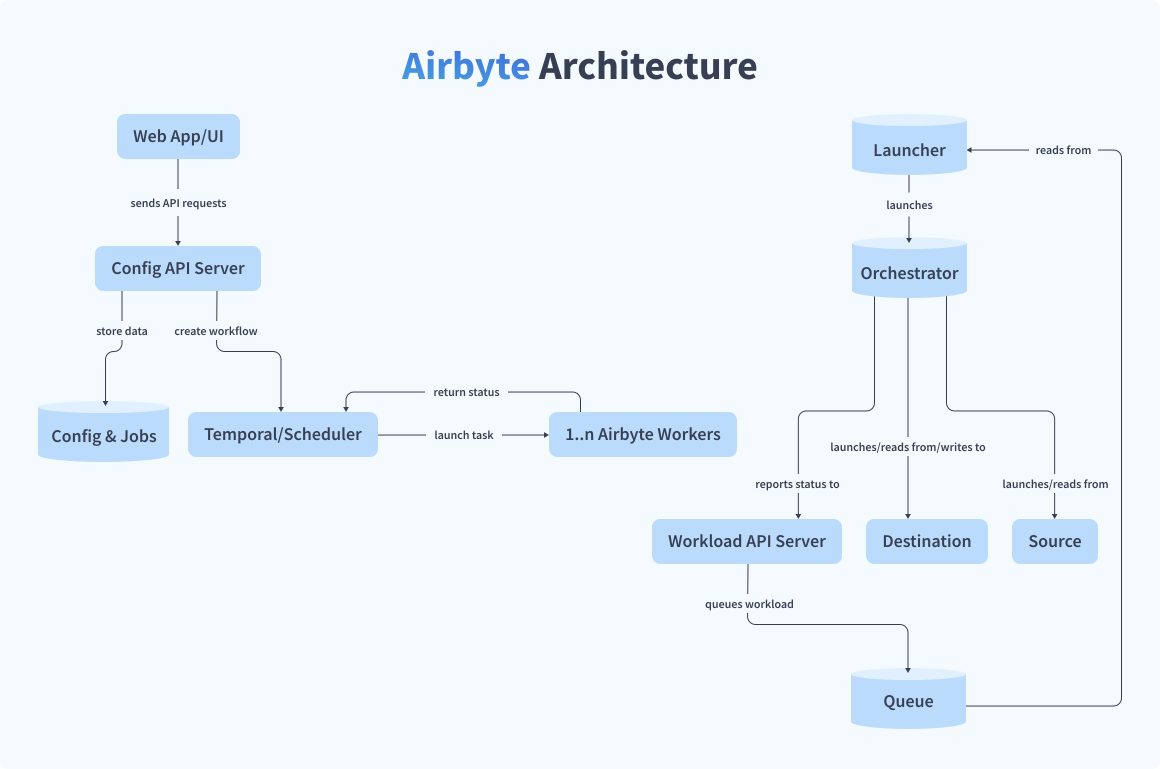
The architectural differences between Airbyte and Airflow highlight their distinct purposes and strengths.
Airbyte focuses on data integration, particularly in syncing data from multiple sources to a destination. Its architecture centers on configurable and extensible connectors.
It is open-source and commonly deployed in self-hosted environments, with a managed cloud option available for teams that want reduced operational overhead. This makes it ideal for teams that need to integrate data from multiple sources with minimal effort.
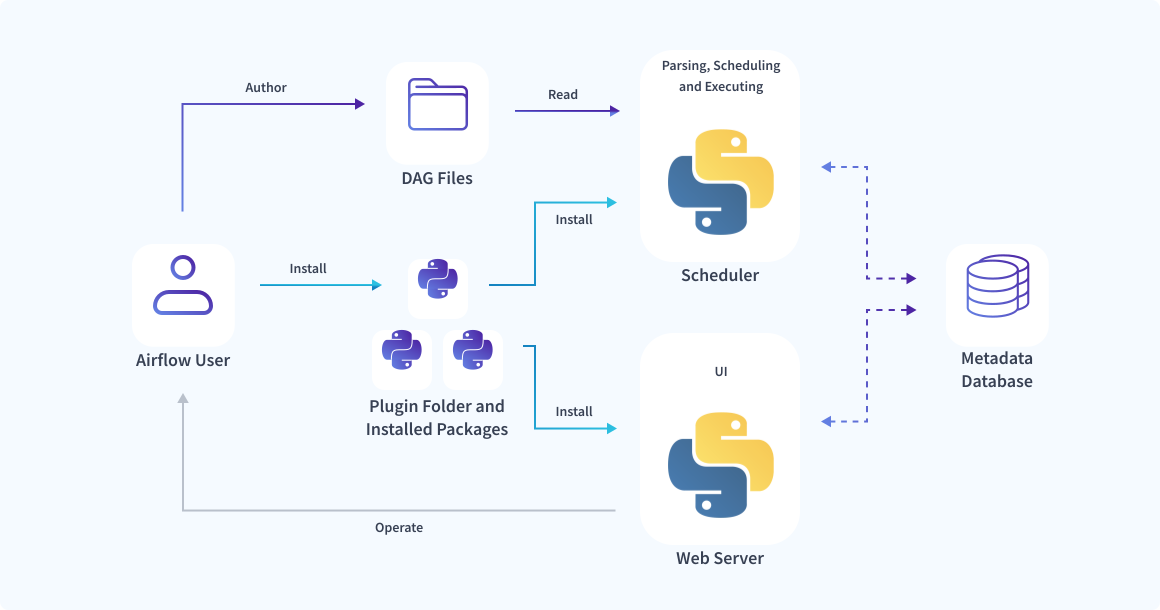
Apache Airflow, on the other hand, is a workflow orchestrator. It doesn’t perform data integration directly, but its modular architecture manages and schedules tasks that might include data extraction, transformation, and loading (ETL) processes.
Recently, Airflow expanded beyond purely time-based scheduling to support asset-aware orchestration, where workflows can trigger based on data availability as well as schedules.
This makes Airflow indispensable for complex pipelines where data movement is only one part of a much larger operational lifecycle.
For detailed comparisons with other tools, have a look at Airbyte vs Informatica and Airbyte vs Rudderstack.


Airbyte vs Airflow: In-depth Feature Comparison
Ease of setup and use
Airbyte offers a managed cloud version that eliminates the need for infrastructure management. The open-source version requires knowledge of Docker or Kubernetes, but it provides clear documentation to help you get started quickly. Most teams can configure initial syncs, although production-grade setups require additional monitoring and availability planning.
Airflow requires more upfront effort, including a metadata database, scheduler, workers, and logging configuration. The learning curve is steeper, especially for teams new to Python-based distributed systems.
Airbyte suits teams that prioritize speed, while Airflow favors organizations that require deep workflow control.
Airbyte:
Airflow:
Connector support
Airbyte provides more than 600 pre-built connectors for databases, SaaS tools, APIs, and files. These connectors manage authentication, pagination, rate limits, and schema changes. When you need a niche source, the Connector Builder guides you through creating custom integrations. However, Airbyte has a mix of connectors where some are maintained by the platform while others are community-maintained. This leads to a varied quality of connectors.
The community maintains more than 80 provider packages that serve as modular extensions integrating with diverse external systems, such as AWS, GCP, or Slack. These providers orchestrate actions, but you must write extraction and loading logic yourself.
Airbyte is a better option if you want ready-to-deploy data integration capabilities. Airflow excels when you need coordination with diverse systems beyond just data sources.
Airbyte:
Airflow:
Operational overhead and maintenance
Airbyte offers community-managed connectors, which can reduce initial setup overhead. But you still manage pipeline configurations, source and destination settings, and some operational aspects within your cloud environment. If you use the open-source version, you hold ownership of backups and scaling, with connector updates needing testing as APIs evolve.
Airflow demands ongoing maintenance of workers, schedulers, and dependencies. However, Airflow 3.0’s Task Isolation has mitigated this by allowing tasks to run in their own environments. Managed services like Astronomer reduce but do not eliminate the need for specialized Airflow expertise.
Airbyte reduces operational burden for integration workloads. So, if you don’t require extensive orchestration, Airbyte is the easier choice.
Airbyte:
Data processing approach
Airbyte focuses on efficient data extraction and loading from sources to destinations, supporting incremental syncs and change data capture. It automatically handles schema detection and normalization, with transformations typically applied post-load using dbt.
Airflow, by contrast, orchestrates any data processing written in Python. It coordinates extraction scripts, transformations, validations, and loads across systems, thereby excelling at dependency management and conditional logic rather than data movement itself.
Choose Airbyte when the primary requirements are data syncs. Airflow suits workflows that involve various processing steps.
Explore the key differences between Airbyte and Stitch to understand their use cases and how they compare to Airflow.
Airbyte:
Airflow:
Pricing structure
Airbyte Cloud offers consumption-based pricing tied to data volume, with capacity-based plans for predictability. The open-source edition is free but incurs infrastructure and maintenance costs. The pricing scales with data growth, which suits small teams but can rise at scale.
Airflow is free and open-source, but the total cost includes infrastructure and engineering time. Managed services, such as Google Cloud Composer and Astronomer, reduce operational work but add subscription fees.
Cost advantage depends on your scenario. Small to mid-sized teams often find Airbyte’s cloud services cheaper than managing Airflow infrastructure. Large enterprises with existing infrastructure may prefer Airflow.
Airbyte:
When to Choose Airbyte
Airbyte works well for teams that want strong data ingestion capabilities without turning orchestration into a full engineering project.
Here’s how to know if Airbyte is the right tool for you:
- You want pre-built data connectors but still control deployment and infrastructure.
- You prefer ELT pipelines with transformations handled downstream.
- You are seeking an option to run open-source and managed cloud pipelines in one platform.
- Your workflows focus on data replication rather than complex task orchestration.
- You are willing to manage infrastructure and scaling when self-hosting.
- You want predictable data ingestion without writing custom extraction code.
Check out our blog post on the top 11 Airbyte Alternatives to compare Airbyte with other data pipeline tools.
When to Choose Airflow
Select Airflow if workflow orchestration flexibility and code-driven pipeline control are important to you.
You should consider Airflow if the following apply:
- You need to orchestrate multi-stage workflows across different tools or systems.
- Your pipelines involve tasks like ML jobs, validations, notifications, or infrastructure tasks.
- You are comfortable writing and maintaining Python code for custom logic.
- You want fine-grained control over task execution, dependencies, and scheduling behavior.
- You already operate distributed systems and can support ongoing platform maintenance.
- You need an event-driven orchestrator rather than a dedicated data ingestion tool.
Why Does Hevo Stand Out?

Hevo stands out because it offers a simple, reliable, and transparent alternative to Airbyte and Airflow. Its no-code interface and 150+ connectors make pipeline setup simple. Its fault-tolerant architecture, auto-healing, and automatic schema handling make it reliable. And unified monitoring with predictable, event-based pricing makes it transparent, giving teams a modern solution without the engineering overhead.
Here’s how it differentiates itself from the two tools:
- Fully managed connectors: Offers 150+ ready-to-use integrations that support real-time, low-latency data syncs without any manual maintenance or API updates.
- Advanced transformations: Provides a visual interface for non-technical users and Python-based scripts for complex in-flight data cleaning.
- Workflow orchestration: Handles ingestion, transformations, retries, and dependencies natively without code.
- Built-in monitoring: Includes real-time alerts, automatic retries, and failure handling to maintain data quality.
- Auto-scaling architecture: Automatically adjusts resources to handle data surges and high-throughput workloads without downtime.
- Transparent pricing: The predictable pricing starts at $239/month with a generous free trial.
- 24/7 human support: Offers live chat and email assistance from expert engineers to resolve technical issues as they arise.
In short, Hevo is an ideal choice if you want fast and scalable data pipelines without managing infrastructure, writing orchestration code, or maintaining connectors.
If you want simpler pipelines without the overhead of Airbyte or Airflow, see how Hevo automates ELT with minimal engineering. Talk to a Hevo expert in a free demo.
FAQs
Q1. Can I use Airbyte and Airflow together in a single data pipeline?
Yes, many teams use them together. Airflow orchestrates Airbyte connections as part of larger workflows. You trigger Airbyte syncs through Airflow DAGs alongside other tasks, like transformations or ML operations.
Q2. What hosting options are available for Airbyte compared to Hevo and Airflow?
Airbyte can be self-hosted using Docker or Kubernetes, or used as a managed cloud service. Airflow is open-source and requires infrastructure management unless you use a managed service, like Astronomer or Google Cloud Composer. Hevo is a fully managed cloud-only service that eliminates all infrastructure concerns.
Q3. Which tool is better for complex workflow dependencies?
Airflow excels at managing intricate dependencies with Python-based logic and conditional branches. Airbyte focuses on data integration without complex orchestration. Hevo provides orchestration for common data pipeline patterns with less customization than Airflow but without the infrastructure overhead.
Q4. How does monitoring compare between Airbyte, Airflow, and Hevo?
Airflow provides built-in real-time monitoring and execution logs through its rich web UI dashboard. Airbyte offers detailed sync monitoring and logs through its interface. Hevo includes comprehensive pipeline monitoring, anomaly detection, and alerting with unified dashboards as part of its managed service.
Share it with your connections.
-
 Share To LinkedIn
-
 Share To Facebook
-
 Share To X
-
 Copy Link