

About Dscout
Dscout is the human signal company, helping the world's best-known brands get the high-fidelity feedback they need to test ideas, iterate quickly, collaborate, and build confidently. For over a decade, the Dscout platform and verified participants have delivered trusted insights for enterprise UXR teams at Spotify, Microsoft, OnePay, Airbnb, Target, Salesforce, and more. With the 2026 release of Dscout AI Studio and Dscout MCP, everyone in an organization can now collect the feedback they need, at the pace the AI era demands. And as more of the world runs on AI, that same panel of verified humans is now delivering the real judgment teams need to evaluate and train their models.
 What do they do?
 Industry
 Location
A small data team serving the whole company
The data team at Dscout sits under the CPO, which places it inside the product organization. Jess Mons, Senior Director on the data team, joined Dscout when the company was around ten people and no centralized reporting existed. They’ve built the reporting function themself, then hired Sean and built out the warehouse with him.
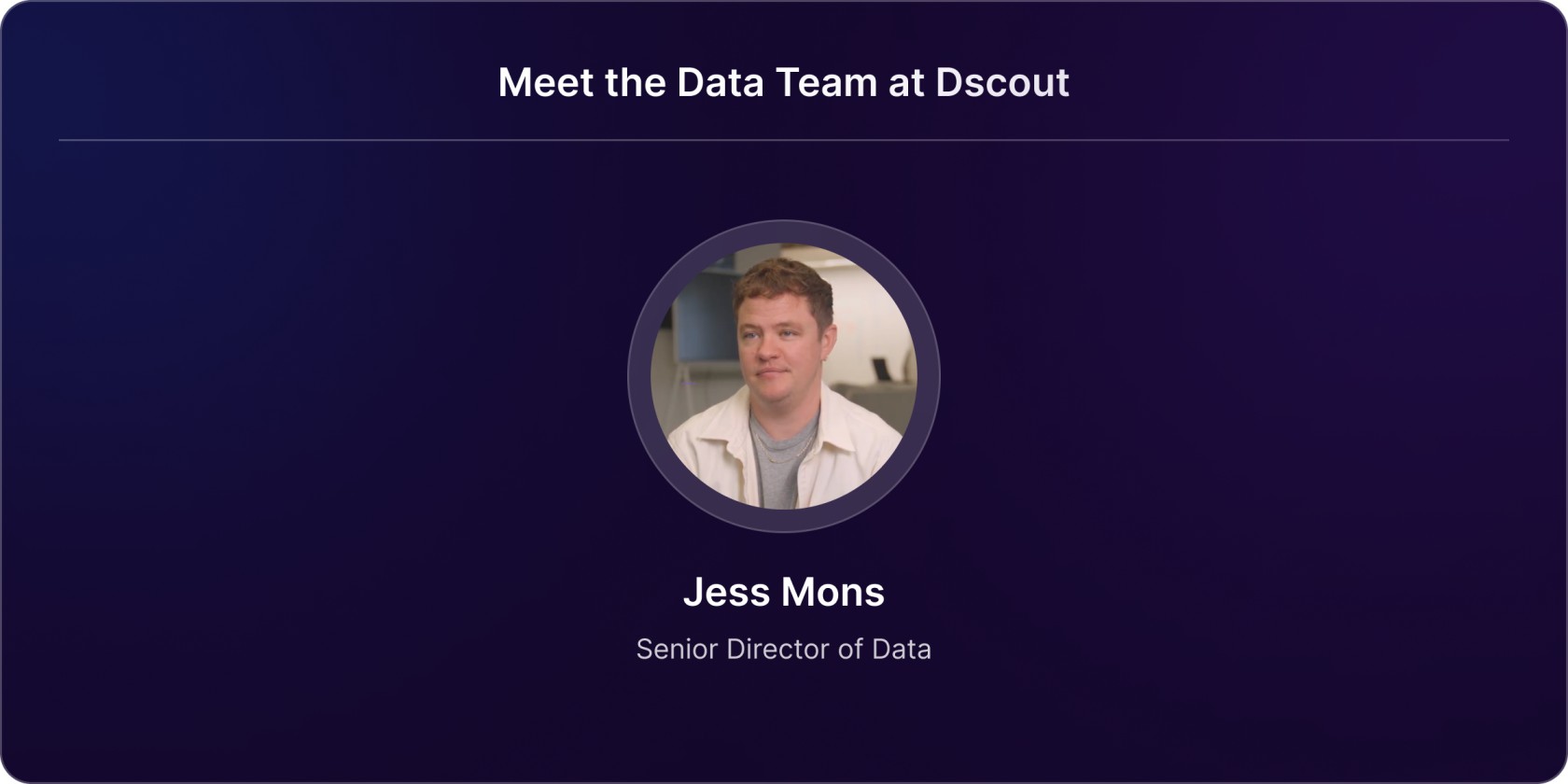
The team stays deliberately small. Its remit covers internal analytics, the productionized data and machine learning that runs inside the Dscout platform, and ad hoc analysis for anyone in the business who needs it. Jess and Sean maintain the pipelines and the warehouse between the two of them, alongside a machine learning engineer and a data scientist who use that data every day.
The data landscape at Dscout
Snowflake is the warehouse. Hevo brings in a copy of the production Postgres database, with PII removed and access controls applied, so that teams can query product data without adding compute to the production system itself. Salesforce, HubSpot, Pendo and a timekeeping platform come in through Hevo as well.
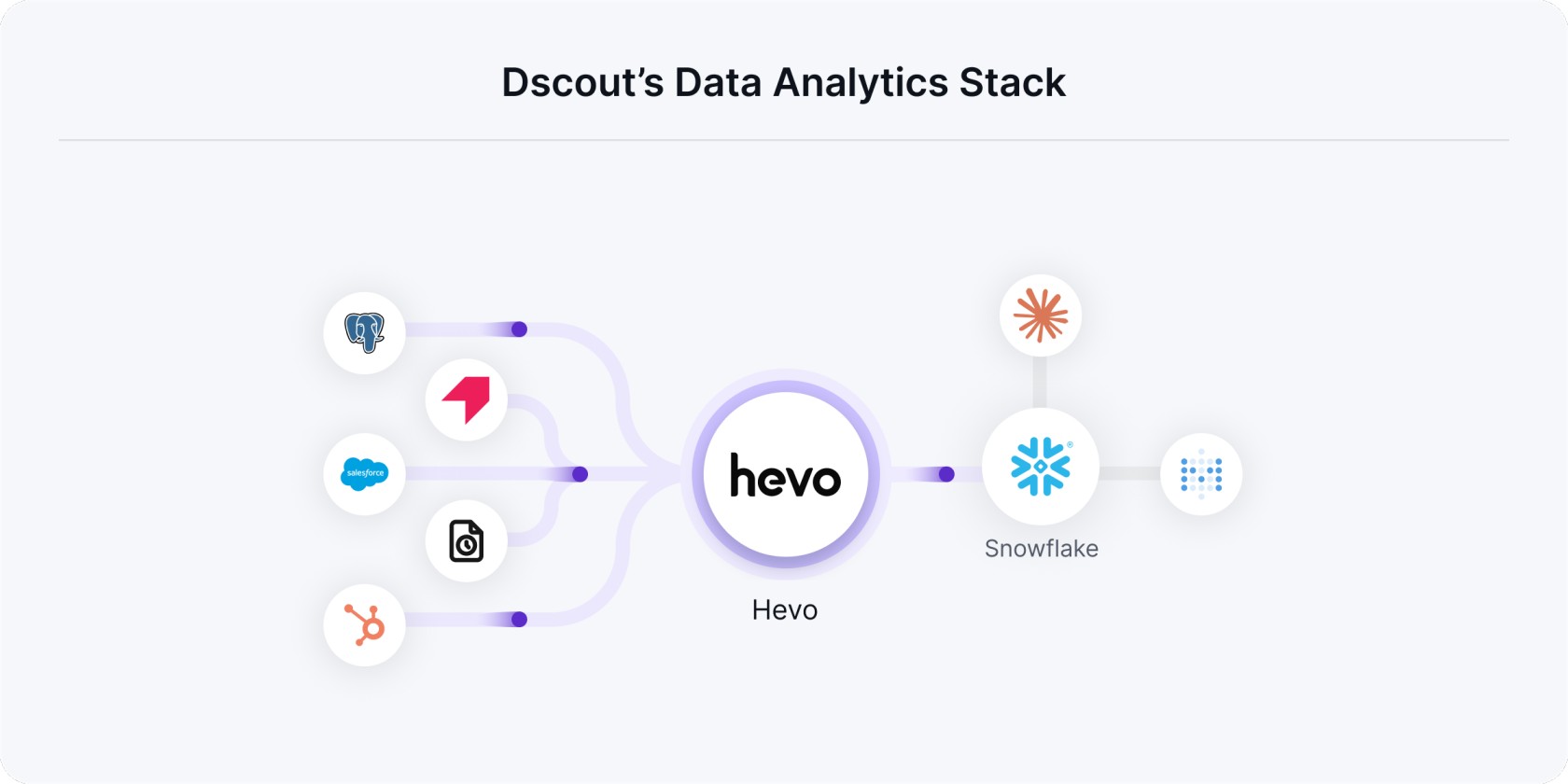
Reporting sits in Metabase, which everyone at Dscout has access to. That access matters more than the tool choice. Product managers write their own queries for feature tracking. The customer success team checks how its accounts are performing and looks at utilization rates. Clients receive usage reports on their consumables. The board deck is built in Metabase each quarter, and the company shares its SaaS and financial metrics internally so that everyone can see how healthy the business is.
Sean has also built an MCP with Claude on top of the warehouse, so colleagues can ask a question in plain language or get help writing a query without routing it through the data team. Reporting at Dscout has moved a long way towards self-serve as a result.
For Jess, the metrics that matter most are the ones describing the participant panel, including how it breaks down, how many participants are active, and how retention and acquisition are trending. Product metrics covering how customers use the platform sit alongside those.
Reporting at Dscout began as a set of custom Python scripts running on a scheduler, pulling data in and updating a Postgres database. That arrangement worked until the volume outgrew what two people could maintain. The team signed with Snowflake and moved its ETL off the custom scripts onto Stitch.
Production data followed a separate path. Engineers and product managers queried a follower database that a nightly job copied over, which meant any question about product usage was answered with data that was a day old at best. About four years ago the team decided to bring production replication fully into Snowflake.
Where the previous tool fell short
Production replication ran through Stitch for roughly a year before the team traced a problem back to it. The methodology that tool uses for change data capture was producing bad data in their environment. Rows went missing. Updates landed incorrectly. For a company whose product is research, data the business cannot vouch for is a serious problem.
Diagnosing it was harder than it should have been. The team had little visibility into when errors occurred or what caused them, and no point of contact to escalate to. The product had changed hands more than once by that point, and support had become effectively non-existent. Even a high escalation went unanswered.

We had zero support. That was part of the reason we moved to Hevo, to have actual people to talk to when things go wrong.
Evaluating a replacement
Two requirements were non-negotiable. The replacement had to sync Postgres correctly, and it had to cover the other internal sources already in use so that the team was not custom-building connectors again. An SLA was the third condition, so that issues could be escalated and answered quickly.
Dscout evaluated Hevo, Fivetran and OpenFlow. Fivetran's pricing model put it beyond what the team could get approved. Their CTO at the time introduced Jess to another data leader already running Hevo, and that conversation carried weight in the decision.
Hevo won on three counts that mapped directly to the requirements. It replicates Postgres using a merge function, which addressed the data correctness problem at its root. It came with a dedicated support team. And it sat at a price point the team could sign off on, even though it represented a meaningful increase over what they had been paying.
The Hevo advantage in action
Correct Postgres replication: Hevo's merge-based approach to Postgres replaced the change data capture method that had been dropping rows and misapplying updates, which restored confidence in the production copy that the whole company queries.
Near real-time production data: What used to be a nightly copy is now accurate to within about ten minutes. That made automations and notifications viable, since they depend on knowing what has just happened rather than what happened yesterday.
One tool across the stack: Salesforce, HubSpot, Pendo and the timekeeping platform run through the same pipelines as production, so the team has not had to build or maintain connectors for internal sources.
Support with a name attached: Jess and Sean escalate directly to a dedicated contact at Hevo and get eyes on an issue quickly, which matters disproportionately for a two-person team that owns both the pipelines and the warehouse.
Less time spent troubleshooting: Over the course of the Hevo contract, the number of times the team has had to investigate a pipeline problem has been drastically lower than it was with their previous tool.
Self-serve reporting across Dscout: A trusted production copy in Snowflake is what allows product, customer success and finance to answer their own questions in Metabase, and what makes an internal Claude MCP useful rather than risky.
Over the course of our contract, the amount of times we have had to troubleshoot something with Hevo has been drastically lower than it was before.
It is a pretty affordable option, the connectors are wide-reaching, and it is a really responsive customer support team.
Excited to see Hevo in action and understand how a modern data stack can help your business grow? Sign up for our 14-day free trial or register for a personalized demo with our product expert.
