

About Riverside
Riverside is a content creation platform used by creators and businesses to record, edit, publish, and repurpose high-quality audio and video. It started in 2020 as a remote recording tool built for studio-grade quality, at a time when most teams were stuck with general video calls. When the pandemic pushed everyone toward sharing content, Riverside grew fast, and the product widened well beyond recording.
 What do they do?
 Industry
 Location
Today the platform covers the full workflow after the record button. Teams edit their footage inside Riverside, host it, turn it into newsletters and webinars, and use AI to find the strongest moments or clean up a clip. It serves both B2B and B2C, with brands such as Spotify and other major media companies on the roster, alongside a large base of individual creators.
Behind the product sits a data function that grew from nothing. When Hernán joined roughly four years ago, the company was barely a year old and had no data team. He was, in his words, a jack of all trades, standing up ingestion, modelling the data, and making it usable on his own. Hevo was already in place by then. His manager, Shira, had made the call to buy it about a month before he arrived.
Four years on, that one-person setup has become a proper data organisation. Hernán leads data engineering, which owns ingestion and shapes raw data to mirror the business. A separate analytics engineering team models data for the teams that consume it. Data analysts build front-end reporting and run the sharper analysis, from A/B tests to specific business questions. A newer agentic team is stitching all that context into an in-house AI engine.
The data landscape at Riverside
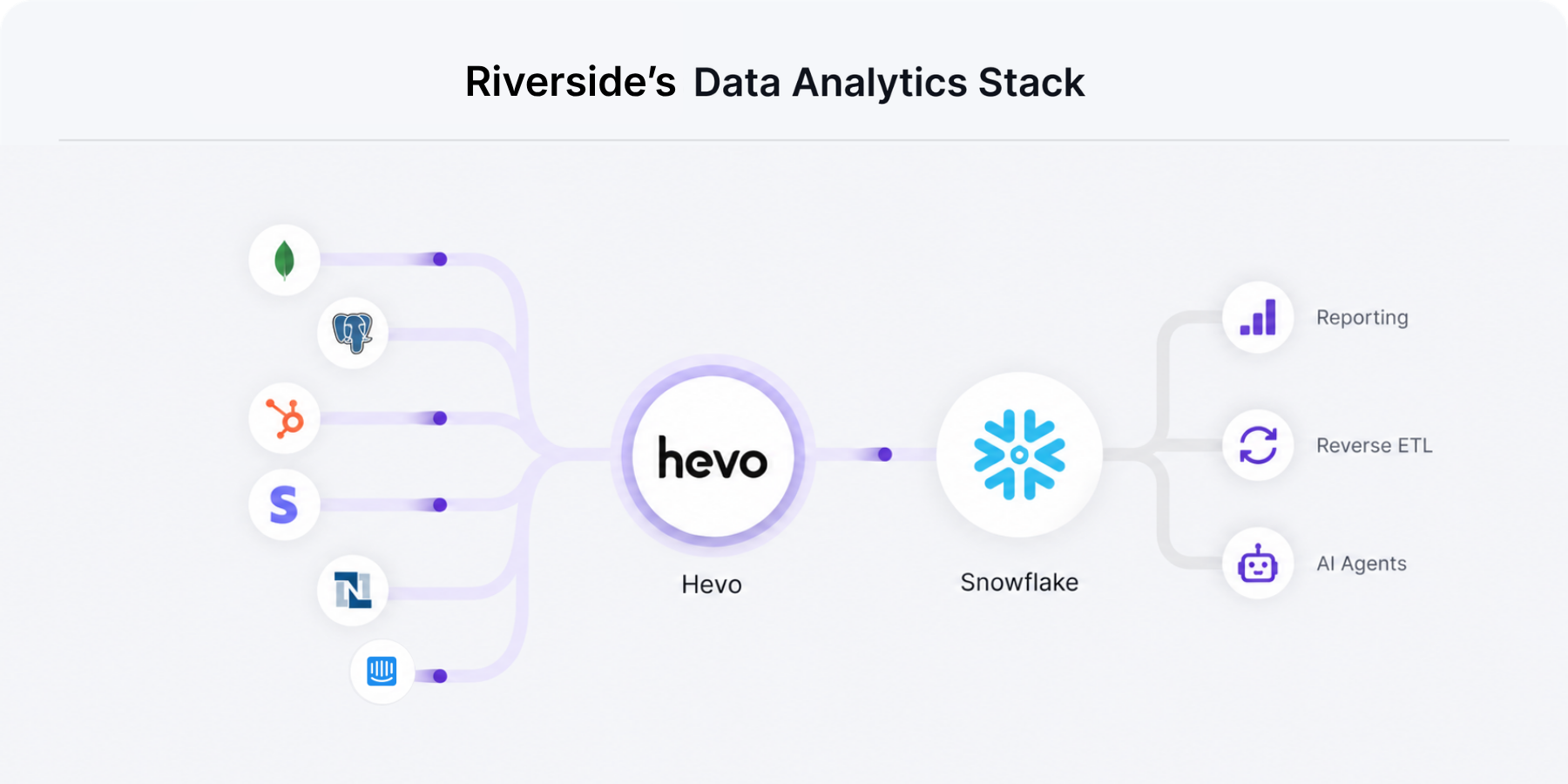
Snowflake is the warehouse and the single place the company trusts for its numbers. Hevo is what fills it. More than 80% of Riverside’s data lands in Snowflake through Hevo, and the data team owns those tool decisions directly, with engineering staying on the product side. A few custom pipelines exist, but only for the rare source where Hevo has no out-of-box connector.
The reach across the stack is wide. Product data comes from MongoDB and Postgres. HubSpot brings the B2B sales data, Stripe handles payments, and NetSuite carries finance. Customer support flows in from Intercom and Zendesk, and marketing pulls from Google Analytics, Facebook, Reddit, and a long tail of ad platforms and spreadsheets. Riverside also runs reverse ETL, sending processed Snowflake data back out to power marketing campaigns and, more recently, features inside the product itself.
Riverside puts this data to work across the business:
Financial reporting covering MRR, subscriptions, and churn, which the team treats as top-priority.
Sales analytics across the deal lifecycle, closed deals, and conversion rates.
Marketing funnel analysis, tracking prospects from the top of the funnel down and finding where they drop off. The team then reads campaign data and interaction transcripts to work out why, not only that it happened.
Product analytics that measure how new features perform quickly, so the team can call what is working while it is still fresh.
Beyond those, the same pipelines feed customer support reporting on ticket trends and satisfaction, and cost analysis out of NetSuite that ties spend back to customers to measure profitability.
Sources (MongoDB, Postgres, HubSpot, Stripe, NetSuite, Intercom, Google Analytics, ads, sheets) ? Hevo ? Snowflake ? Reporting, Reverse ETL, AI agents
How Riverside’s data stack grew up
FROM SPREADSHEETS TO MANAGED PIPELINES
Before Hevo, running data at Riverside meant plugging BI tools straight into source systems and patching the gaps with spreadsheets. Any extra number lived in a sheet somewhere. Hernán describes that early state plainly. It was a mess. The company needed a dependable way to combine data and pull it on a schedule, and doing that by hand was never going to hold.
The buy-versus-build question settled itself. A reliable connection to a source like MongoDB, kept running over years, would have meant dedicated engineering headcount to build and maintain it. That work sits far from what Riverside is actually good at. So the team bought something proven and pointed its engineers at the product instead.
The quest for the ideal data integration tool
Hevo has come out ahead on value per dollar, and the team has chosen to stay with it.
The reasoning is simple. Building and maintaining connectors for heavy sources is expensive work that produces nothing customers see. A well-established tool that lets the team connect a source and get moving is worth paying for.

If you want to focus on delivering value, you buy something well established that you know works, like Hevo, instead of building it yourself and replicating what was never your core.
The Hevo advantage in action
Four years in, the reasons Riverside keeps choosing Hevo have held steady:
Reliable, transparent pipelines: More than 80% of Riverside’s data runs through Hevo. The team connects a source, fills in the collection details, and the data lands in Snowflake. That part of the experience has not changed in four years, even as the product and its data sources kept growing.
Near real-time on the source that matters: MongoDB carries first-party product data and makes up around 70% of consumption. Hevo ingests it hourly, so the data the business leans on stays fresh.
Support that moves fast: A dynamic product means source APIs keep changing, and glitches happen. When they do, the Hevo team works them quickly, with a standing point of contact who stays on top of the tricky sources.
Lower cost than building it in-house: No dedicated headcount goes toward maintaining heavy sources like MongoDB. Building and running those connections would mean hiring engineers to do work that sits far from the product, and Hevo has held its value-per-dollar edge at every review.
One tool across the whole stack: Product, CRM, finance, support, and marketing ad data all arrive in Snowflake through Hevo, which is most of the ingestion the team needs in one place.
We just want to connect to the data. We fill in the collection details and it flows. That part has stayed the same the whole time, even as everything around it changed.
What Riverside is building next
Riverside is building analytics agents for the company. The team pulls Hevo-ingested data together with other sources, then remodels it into a shape the agents can read, so an LLM returns an accurate answer rather than a plausible one. A large share of the data feeding that work comes in through Hevo.
The same data is starting to close the loop back into the product. Snowflake outputs now power features the engineering team cannot compute directly. Data that once only served advertising and sales is now shaping the product itself, powering things like badges that recognise users for creating clips, hosting webinars or podcasts, or using AI tools, encouraging them to try more of the platform's features.
For Riverside, the work with Hevo laid the groundwork for a scalable, AI-ready data foundation. As the company keeps expanding what it builds for creators, Hevo stays the layer that gets the data where it needs to be.
Excited to see Hevo in action and understand how a modern data stack can help your business grow? Sign up for our 14-day free trial or register for a personalized demo with our product expert.